





Guide to the NoMachine Server GUI (v.5)
| Install any of the NoMachine server products on the remote machine you need to access, and the client software on the device from which the user will connect. | ||
| The server software is up and running and ready to start as soon as the installation is completed. To complete the installation reboot when requested. | ||
| The default configuration is suitable for the greatest number of environments but if a special set-up or behavior is needed, you may configure the server from its graphical interface as explained below. | ||
| To start the connection instead, please consult this users' guide: https://www.nomachine.com/getting-started-with-nomachine | ||
| Consider that on the user's device you need to install a NoMachine client. For any of the supported platforms it's possible to install NoMachine free as an alternative: it will provide also the server functionality to give access to its host. |
| 1. NoMachine Preferences and Custom Settings for the Server |
You may access the graphical interface to administer your server and choose your custom settings in two ways:
1) Click on the !M icon in the system tray to open the menu. Then click on Show the server status and finally on Server preferences.
or
2) Launch NoMachine from your program menu, click on Settings and then on the Server preferences link at the bottom of the panel.
The NoMachine Server preferences interface is made of six tabs to switch about the available configuration panels: Services, Security, Devices, Transfers, Performance and Updates.
IMPORTANT
a) Note for NoMachine free users
Labels above are named Show the connection status and Connection preferences in the free version.
b) Administrative rights are required
Check on the bottom left of the Preferences panel to see if changes are disabled (default) or not.
By clicking on the Changes disabled link you will be requested to provide authentication credentials for a user with administrative privileges.
You will be prompted with the same request also when trying to modify any of the available settings if changes have not been previously enabled.
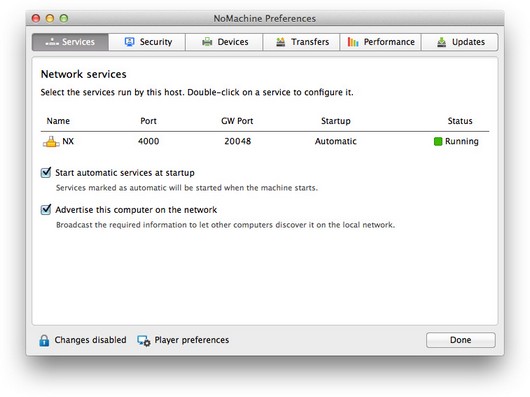
Fig 1 - The Connection preferences (or Server preferences) panel to configure your server
| 2. The Services Panel. Start and Stop a Service or Change its Port |
The Service panel shows the current status of NoMachine Network services, but not of the server itself.
To see the NoMachine server status:
- Click on the !M icon in the system tray.
- Click on 'Show the server status' (or 'Show the connection status' for NoMachine free).
You will be able to turn on/off the server. When choosing to shutdown the server you will be requested if the server has to be automatically restarted when rebooting.
See: https://www.nomachine.com/disabling-access-to-your-local-desktop for more detailed instructions.
In the Service panel, NoMachine Free provides only 'NX' which is the NoMachine network service in charge of accepting connections by NX protocol.
Click on any of the listed service to access its administrative panel where you can:
a) Change the local port for the service(e.g. NX is using by default port 4000, you may change it to for example 4200): this is the Service port.
b) Change the port mapped in the router or firewall to allow connections over the Internet: this is the Gateway port.
Port mapping is enabled by default only for NoMachine free. For all the other NoMachine server types it's necessary to flag the Gateway port to enable it.
TIP
You may also disable the port mapping by unflagging the Gateway port if you do not expect connections from outside your private network.
TROUBLESHOOTING
The automatic port mapping requires that the router supports the UPnP or NAT-PMP protocol. Otherwise it will be necessary to configure the router manually and open the requested port. For example if you use NoMachine free, you will need to open port 4000 on the router and map it to the public IP address of your NoMachine (server) host.
See also: https://www.nomachine.com/AR11L00827
c) Define if the service has to be automatically started at every reboot (this is Start mode -> Automatic) or manually started (Start mode -> Manual).
In this last case, access the Preferences -> Services panel to start the service whenever necessary.
d) See the current status of the service, Stop and then Start it or Restart the service.
IMPORTANT
Restarting the NoMachine server is requested.
When changing the service port it's always requested to restart the NoMachine server. This will terminate all current connections and on Linux it will terminate also all virtual desktops, even those disconnected.
The NoMachine networks services installed on the system depend on the NoMachine server type and on the platform:
| Network Service | Program name | Scope | Default port | Available with | Platforms |
| NX | nxd | Accept connections by NX protocol | 4000 | NoMachine, Enterprise Desktop, Workstation, Small Business Server, Terminal Server, Enterprise Server, Cloud Server (*) | All |
| HTTP and HTTPS | nxhtd | Accept web connections | 4080 and 4443 | Workstation, Small Business Server, Terminal Server, Enterprise Server v. 5.2 or later (**) | All |
| SSH | nxsshd | Accept connections by SSH protocol | 4022 | Enterprise Desktop, Enterprise Server, Cloud Server | Windows |
(*) NoMachine Cloud Server is no longer available since v. 5.2 and has been replaced by the Enterprise Server
(**) For versions up to v. 5.2, web sessions are supported only by NoMachine Cloud Server
From the Services panel you may also:
e) Manage the automatic start of services.
Select Start automatic services at startup to ensure that all services with the Startup option set to 'Automatic' will be started when the host machine is rebooted, see point c).
f) Manage the visibility of this computer to NoMachine users in the same local network.
Select Advertise this computer on the network to let other computers running NoMachine find this computer on the local network. This computer will not be visible outside the private network.
This tutorial for end-users explains how to look for a NoMachine computer over the local network:
https://www.nomachine.com/finding-other-nomachine-computers-on-the-same-network
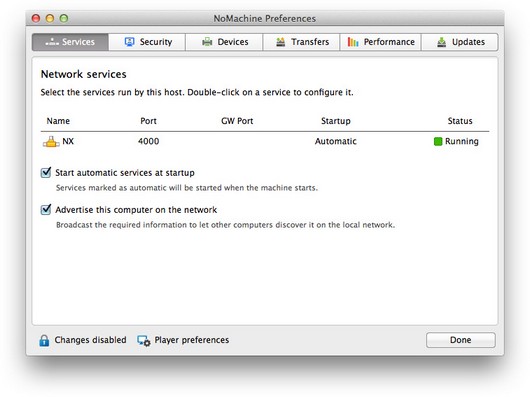
Fig. 2 - The Services panel for NoMachine free
| 3. The Security Panel. Configure Users' Interactivity Level and Notifications |
The Security preferences panel allows to configure the users' level of interactivity with the desktop, and notifications about incoming requests for connections.
a) Automatically accept the incoming connection or ask for the desktop owner's authorization.
Select Require permission to let remote users connect when the explicit approval of the desktop owner is necessary. This option applies only to connections to the physical desktop when the connecting user is not the desktop owner. If the incoming user is the desktop owner, he/she will always connect and no request for authorization is issued.
The request for desktop owner's authorization is enabled by default.
TIPS
If users will be accessing a computer running unattended, it's necessary to turn off Require permission to let remote users connect otherwise the user will be unable to connect.
For Linux virtual desktops, the desktop owner's authorization is requested by default when the connecting user is not the desktop owner. This can be disabled by editing manually the server configuration file (server.cfg), uncommenting and setting this key: VirtualDesktopAuthorization 0).
b) Configure the interactivity level with the desktop.
By default the connected user can interact with the desktop. Check Require permission to let the remote user interact with the desktop to let the desktop owner allow or forbid the user to interact with the desktop.
This option applies only to connections to the physical desktop when the connecting user is not the desktop owner. If the incoming user is the desktop owner, he/she will always be able to interact with the desktop.
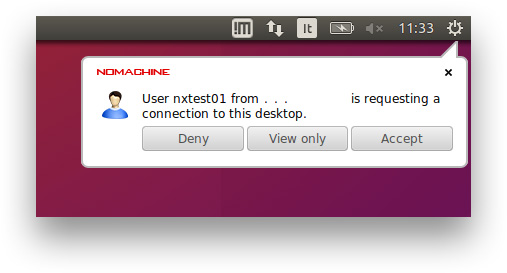
Fig. 3 - The desktop owner receives a request to authorize the interactive level for the connecting user
TIP
Switching between the view-only mode and the interactive mode is possible at any time without the need to restart the connection. Click on the !M icon in the system tray to open the menu and select Yield keyboard and mouse. This will open the list of the connected users: select the user who will have exclusive control on keyboard and mouse. This option doesn't apply to the owner of the physical desktop.
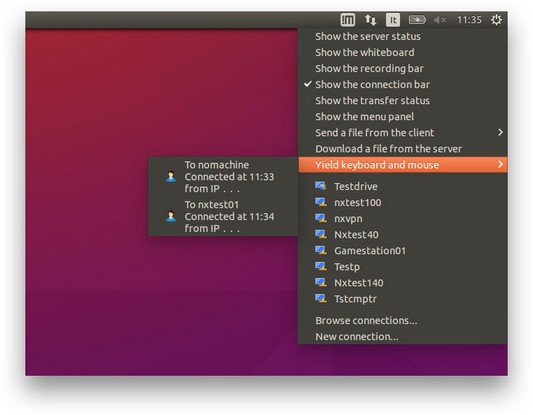
Fig. 4 - Choose the user who will control keyboard and mouse, all the other users's session will be in view-only mode
c) Manage the display of the !M icon in the system tray.
When NoMachine is up and running, the !M icon is always present in the system tray. If it's necessary to not show this icon, select Hide the NoMachine icon in the system tray. Note that all notification pop-ups (for example about a user being connected) will be still displayed.
When the !M icon is not displayed, the server administrative interface may be accessed from the NoMachine GUI, see point 2) at Chapter 1.
d) Sound notifications.
By default sound notifications for users' connection and disconnection are enabled, as well as when notification dialogs requesting for user's interaction are issued (for example the dialog asking for the user's interaction level). To disable sound alerts, unflag Use sound notifications when there is an event.
e) Screen blanking
When the user connects to the remote physical desktop it's possible to activate the Lock the physical screen when somebody is connected option. In this case only a black screen will be displayed on the physical monitor of the server host. The local user in front of the physical monitor will be not able to interact with the desktop until the NoMachine user logs-out.
TIP
More details and instructions about how to use the screen blanking are available here:
https://www.nomachine.com/blanking-the-host-screen-during-remote-control
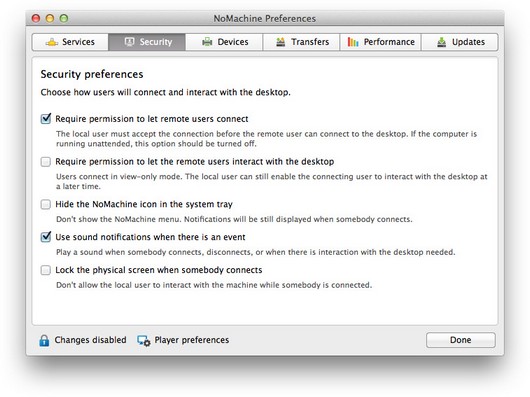
Fig. 5 - The Security Panel
| 4. The Device Panel. Enable or Disable the Sharing of Printers, Disks, USB Devices and Others |
From this panel it is possible to manage which kind of devices can be shared within the session. Uncheck any of the available options to forbid the sharing of the selected device. This will apply to both directions: users will be not able to mount a local device from their machine to the remote session and a remote device will be not connected from the server host to the user's machine.
Once the user connects he/she will be able to share a device from the NoMachine menu panel. To open it inside the session, click on the page peel in the the right upper corner of the window or use the Ctrl+alt+0 key combination.
Refer to the following end-user's guides for step-by-step instructions to share devices:
- For users connecting from Windows https://www.nomachine.com/DT07M00087
- For users connecting from Mac https://www.nomachine.com/DT07M00083
- For users connecting from Linux https://www.nomachine.com/DT07M00086
Devices that may be connected inside the NoMachine session are:
a) Disks
When this option is enabled, disk partitions can be mounted inside the session making their file system accessible. This is a two-way service and can be used for example for transferring a file from the remote desktop directly to a folder on the user's computer or vice-versa.
Users may decide if their connected disks will be private or public. A private disk is accessible only by the user who connecte it, public disks will be available for all users who will connect to the same (physical or virtual) desktop. By default private disks are mounted in the user's desktop, while public disks are mounted in the following directories:
- on Windows in C:\Users\Public
- on Linux in /media
- on OSX in /Volumes
TIP
Other ways to copy a file between the user's device and the remote server host:
- Drag and drop the file from the local desktop to the remote desktop in the NoMachine session or vice-versa.
- Use the transfer file option available in the !M menu (click on the !M icon in the system tray to open it).
See here for a step-by-step guide for using file transfer:
https://www.nomachine.com/sharing-files-between-computers
b) Printers
When this option is enabled, two-way printing is supported: client-side printers can be integrated with the server-side printing subsystem and vice-versa.
Note that since the CUPS printing subsystem (on Linux and Mac) doesn't accept printer names containing spaces, NoMachine replaces a blank space with an underscore.
When users print from their PC to a printer on the remote printer in a session running on Linux, they cannot have feedback on the print job status due to a limitation of the printing subsystem.
When connecting their printer, users may make it private or public. A private printer is accessible only to the user who shared it, while a public printer will be available for all users.
TROUBLESHOOTING
Specific system configurations may be requested when the NoMachine server is on Linux or Mac systems
When the NoMachine Server is installed on Linux or Mac it's possibile that the printing system doesn't work out-of-the-box and some configurations on the server host may be required.
In particular:
- Print with CUPS 1.4 or later: https://www.nomachine.com/AR05K00674
- Print to Mac 10.10: https://www.nomachine.com/AR09M00860
c) USB devices
When this option is enabled, users can forward USB devices over the network such as hard disk, web cams, barcode readers, and pen drives from local to remote desktops and vice-versa.
Note that when users forward a local USB device to the remote session, this devices is connected on the remote machine and is no longer visible on the user's computer. For example, if it's a pendrive, it will stop to blink on the user's computer until it is connected with NoMachine. If it's a mouse, all inputs will be transferred on remote and will not have any effects on the user's local cursor.
TROUBLESHOOTING
Note for NoMachine server installations on Linux
If the USB service is disabled in the Server preferences interface, it is likely that the USB module has not been compiled on your Linux during the installation of NoMachine. Instructions for manually compiling the USB module are available here: https://www.nomachine.com/AR12J00658
d) Smart card readers
When this option is enabled, users may forward the smart card reader plugged into their computer to the server host and make available the smartcard authentication inside the session. This can be integrated with a Kerberos Ticket system for example to implement single sign-on (SSO).
The users's smart card device should support the PKCS#11 industry standard for smart card interfaces.
e) Network ports
When this option is enabled, users can create virtual network interfaces and establish a bridge between local and remote sides or vice-versa to provide transparent access to network resources. This service allows access to any of the default network servers like Samba, CUPS, FTP, SSH and Telnet or any other type, for example a MySQL server.
f) Sound forwarding
The Devices panel provides a further option to disable audio: uncheck Enable audio streaming and microphone forwarding to avoid that sounds or music played inside the session is forwarded to the user's device. The same applies to the user's microphone.
TIPS
For end-users
When users connect to the physical desktop, they may decide if forwarding their audio or not in the 'Audio streaming' panel that is displayed at session start-up. By default the 'Mute audio on the server while I'm connected' option is enabled and audio played inside the NoMachine session is not played on the server host.
By default microphone is always disabled: users will have to activate it from the NoMachine menu panel inside the session, by clicking on the 'Mic in' icon button. Click on the right upper corner of the session window to open the menu or press Ctrl+Alt+0.
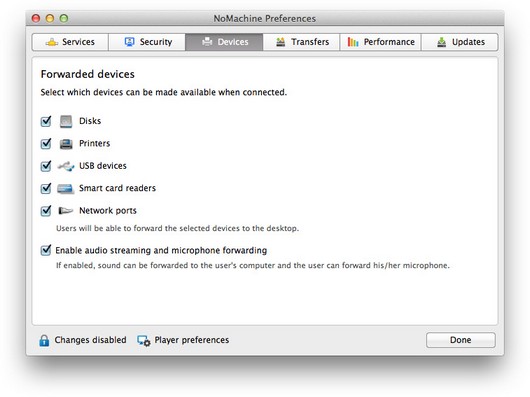
Fig. 6 - The Devices Panel
TIP
Connecting disks, printers, USB devices and Network ports are all two-ways services. It's possible to disable the device forwarding only from client to server or vice-versa by manually editing the node configuration file (node.cfg). For more detailed instructions, refer to:
https://www.nomachine.com/DT07M00089
In case of a multi-node environment, the custom configuration should be applied to each node.
| 5. The Tranfers Panel. Configure File Transfer Options (Download Folder and Permitted Size) |
From this panel it's possible to:
a) Forbid users to upload files from their devices to the remote server. Uncheck the Allow clients to upload files option for that.
The available configurations for files to be uploaded on the server host, when 'Allow clients to upload files' is enabled, are:
a.1) Limit the size of files to be uploaded. Check the Disallow files bigger than option and specify the size in MB. Default is 100 MB.
a.2) Specify the directory where the uploaded files will be saved on the server: check the Automatically save files in option and choose the preferred path.
b) Forbid users to download files from the server host to their devices by unchecking the Allow clients to download files option.
When 'Allow clients to download files' is enabled, it's possible to:
b.1) Limit the size of files to be downloaded. Check the Disallow files bigger than option and specify the size in MB. Default is 100 MB.
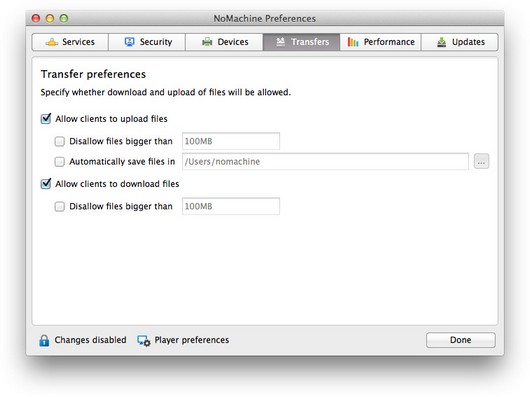
Fig. 7 - The Transfers Panel
TIP
The users's guide illustrating how to upload or download a file using the file transfer service is available here:
https://www.nomachine.com/sharing-files-between-computers
| 6. The Performance Panel. Choose the Display Encoding Method and Others |
From this panel you may select the display encoding to be used for the NoMachine video streaming technique. Video streaming techniques apply to:
- connections to physical desktop
and
- virtual desktops, but only when the lightweight mode is disabled.
It doesn't apply to virtual custom sessions in lightweight and non-lightweight mode and to virtual desktops in lightweight mode (default).
a) Select Use a specific display encoding if you need to modify the encoding.
In general VP8 and H.264 are suitable for all situations, while MJPEG can be an alternative when the end-user's computer is less powerful and the user is experiencing slow responsiveness.
IMPORTANT
Note for H.264 encoding
NoMachine free and all the server evaluation versions don't provide the H.264 encoder. This is available only with subscribed packages downloaded from the Customer Area.
NoMachine or evaluation users may consider to build the libx264 on the NoMachine server host as explained here: https://www.nomachine.com/AR10K00695
or acquire a NoMachine AVC pack.
The H.264 decoder has to be present on the users' machine: https://www.nomachine.com/AR10K00696 or the H.264 encoding cannot be used.
b) The Request a specific frame rate option refers to the number of images that are displayed in one second of video streaming.
If you enable this option, consider that using a higher frame rate allows to reproduce motions more smoothly but requires more CPU and may slow down other applications running on the server host. Deciding to use a higher or lower frame rate mainly depends on what users will play and on the server host HW resources. For example watching an action movie or game may require a higher frame rate while a lower frame rate should be enough for surfing the web or using an application.
c) NoMachine supports 3D hardware acceleration for display encoding.
To enable support for HW acceleration, select the Use acceleration for display processing option. This will enable use of hardware acceleration for frame processing on the server.
Due to the huge possible combinations of drivers, video cards and operating systems, it is possible that hardware acceleration doesn't work with NoMachine. In this case it's suggested to disable it.
IMPORTANT
Note for virtual desktops on Linux running in lightweight mode
Hardware acceleration is supported also for virtual desktops running in lightweight mode through the use of the VirtualGL library. To enable it, refer to this article: https://www.nomachine.com/AR11K00737
TROUBLESHOOTING
For Windows users:
NoMachine doesn't use H.264 hardware-accelerated decoding on Windows clients when the resolution of the remote monitor is higher than 1920x1080: https://www.nomachine.com/AR09L00811
d) For NoMachine servers running on Linux and supporting virtual desktops, a further option allows to enable or disable the lightweight mode: check or uncheck Use lightweight mode in virtual sessions.
The lightweight mode is enabled by default. It reduces the bandwidth usage (and the HW requirements because it is less CPU intensive) on both client and server by optimizing the X11 protocol by means of compression techniques, round trip suppression and cache algorithms. This method is convenient when working with traditional GUIs or large amount of text to avoid loss of image quality, but it's not suggested for multimedia contents or applications with many graphical effects.
More indications may be found here: https://www.nomachine.com/AR04M00845
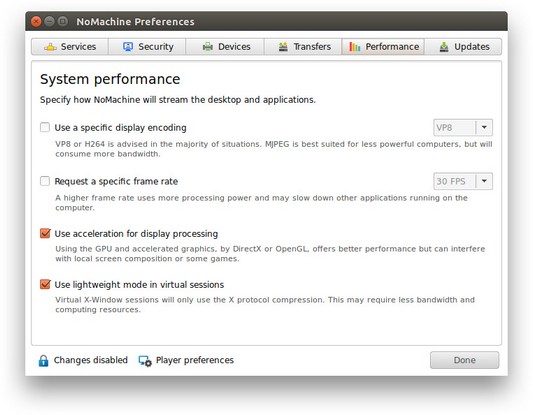
Fig. 8 - The Performance Panel
| 7. The Updates Panel. Configure the Automatic Software Updates, Check Version and Manage your License |
From the Updates panel you may manage the automatic software updates and your licenses.
a) Software updates.
NoMachine software by default is configured to fetch the repository for automatic updates. To disable it, unflag the Automatically check for updates option. When this is instead enabled, it's possible to let the software download the updates automatically by selecting Install updates in background.
Installing updates always require an explicit approval.
For more information about the automatic software updates, see:
https://www.nomachine.com/DT07M00085
b) Version and License.
The License information field in the Updates panel reports information about the product type and the current version.
From the same section you may read the license by clicking on the <server.lic> or <node.lic> link. The Replace button allows to navigate through your computer directories to load a new license file.
Replacing the license is necessary in the following cases:
1) A fresh new installation made with the server package labeled for production (downloaded from the Customer Area).
Replace the package license (server.lic an node.lic) with the customer license you have received at the time of your purchase, This license may be also downloaded from your Customer Area.
2) Your customer license has expired and you might want to replace it with a valid one.
3) You are using an evaluation version and have received a new license from our Sales Team to extend the trial period.
IMPORTANT
License of NoMachine free never expires. In case of a different behavior due to leftovers from a previous installation, we suggest to uninstall NoMachine, delete the installation directory if present, re-install NoMachine.
Only packages downloaded from the Customer Area and labeled for Production contain the H.264 libraries. It's therefore advisable to uninstall the evaluation version and proceed with a clean install of the server package for production. To preserve custom settings applied to the server for evaluation you may try to upgrade the installation with the correspondent package for production. Installations can be upgraded only with the same server type. I.e. if you have installed a NoMachine Terminal Server, you cannot upgrade it with an Enterprise Server package.
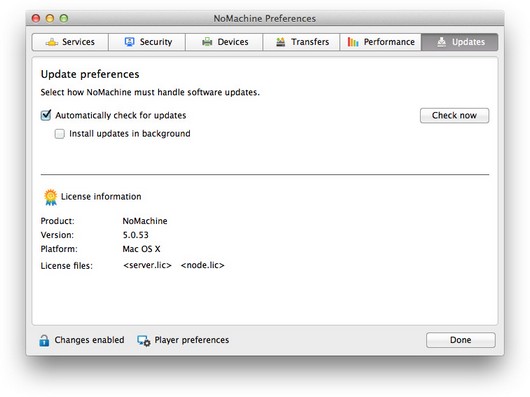
Fig. 9 - The Updates Panel
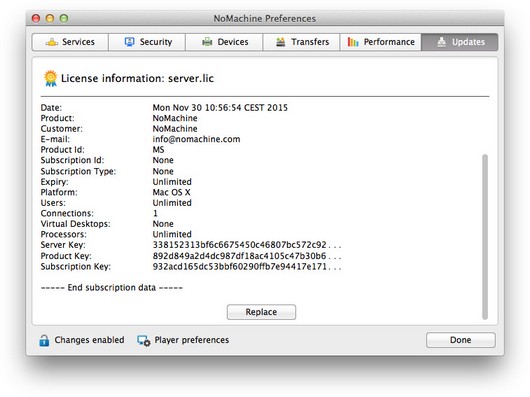
Fig. 10 - The License information panel displaying the server.lic license for NoMachine free and the Replace button.
Other references
A quick introduction to the NoMachine GUIis available at:
https://www.nomachine.com/DT11M00106
To administer the server from command line and for more configurations, please refer to the server's Administrator Guide:
https://www.nomachine.com/DT07M00090
Instructions for advanced functionalities such as multi-node support, cluster failover, profile rules are instead provided here:
https://www.nomachine.com/DT07M00091
The full set of documents, included installation and configuration guides and tutorials for end-users can be found at: