




Prerequisites for federating Enterprise Servers and their nodes under one Cloud Server (v. 4)
|
This document is intended to provide general guidelines for understanding which NoMachine products and licenses are necessary to set-up an environment with Enterprise Servers and their remote nodes federated under a Cloud Server.
|
||
|
The Cloud Server will provide the entry point to reach via web the Enterprise Server(s). Each Enterprise Server can be configured to work in a multi-node environment and manage from 1 to N NoMachine nodes. Please read here for instructions and server commands to set-up a multinode environment: https://www.nomachine.com/DT04L00067
Note that each Enterprise Server has to be configured separately for the multi-node support, the Cloud Server will not provide tools to administer that. By default, the Cloud Server is configured to connect to the server installed on the same host (localhost). To make the Cloud Server able to connect to different Enterprise or Cloud servers, please follow instructions here: https://www.nomachine.com/AR07K00679 |
Minimum requirements to federate Enterprise Servers and their nodes under a Cloud Server
The minimum requirements to federate two Enterprise Server under a Cloud Server are:
- 1 NoMachine Cloud Server on machine "A".
- 1 NoMachine Enterprise Server on machine "B", let's call it Enterprise Server 1.
- 1 NoMachine Enterprise Server on machine "C", let's call it Enterprise Server 2.
- 1 node for the Enterprise Server on B (machine "D").
- 1 node for the Enterprise Server on (machine "E").
On the server hosts (Windows, Mac, Linux) you have to install:
NoMachine Cloud Server on A
NoMachine Enterprise Server on B.
NoMachine Enterprise Server on C.
Node machines D and E are intended to be ruled respectively by Enterprise Server on B and Enterprise Server on C.
If the node host is Linux you can install one of the following products:
- NoMachine Terminal Server Node
- NoMachine Workstation
The main differences are:
- The Terminal Server Node product supports unlimited concurrent virtual Linux desktop sessions but doesn't allow to start connections directly on its host (the server functionality is not present).
- NoMachine Workstation is a fully operative server installation, i.e. you can connect to the Workstation host directly. Stop the Workstation server to avoid this. It supports 4 concurrent virtual Linux desktops.
If you plan to have multiple nodes Windows, Mac or Linux and you need to give access to their physical desktop you can install:
- NoMachine Enterprise Desktop that is a bundle of 10 licenses valid for 10 physical machines/VMs.
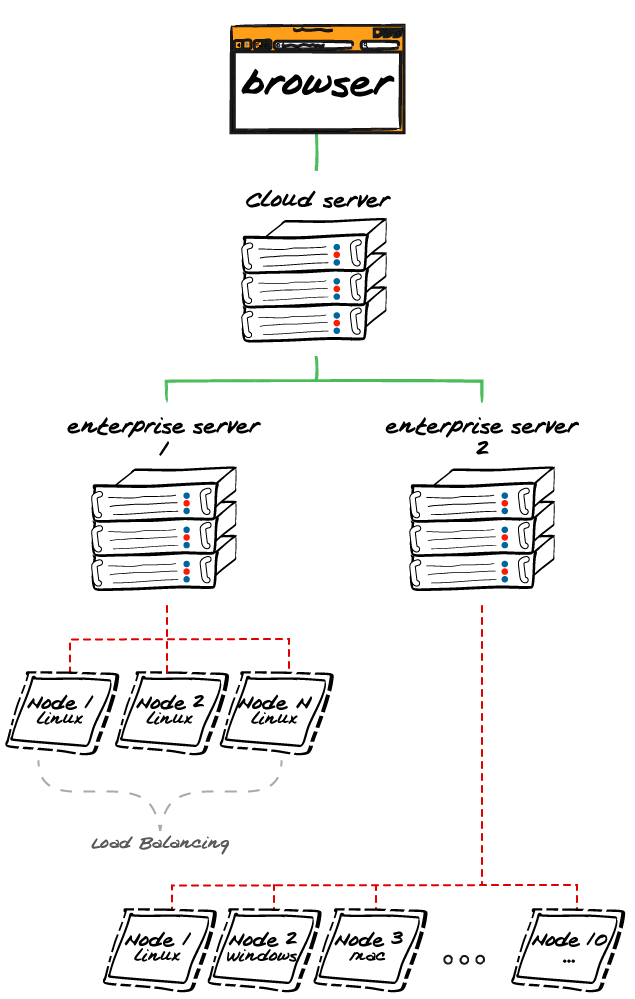
Diagram below shows two Enterprise Servers federated under a Cloud Server:
Enterprise Server 1 has a multi-node environment with load-balancing of virtual Linux desktop sessions. Enterprise Server 2 has a multi-node environment with access to physical desktops on the nodes: